Chief AI
Meet Chief.
The AI co-pilot that calls, drafts and flags across all three apps, after your team approves.
What Chief does today
Summaries
One AI summary per patient before the visit.
Watchlist findings
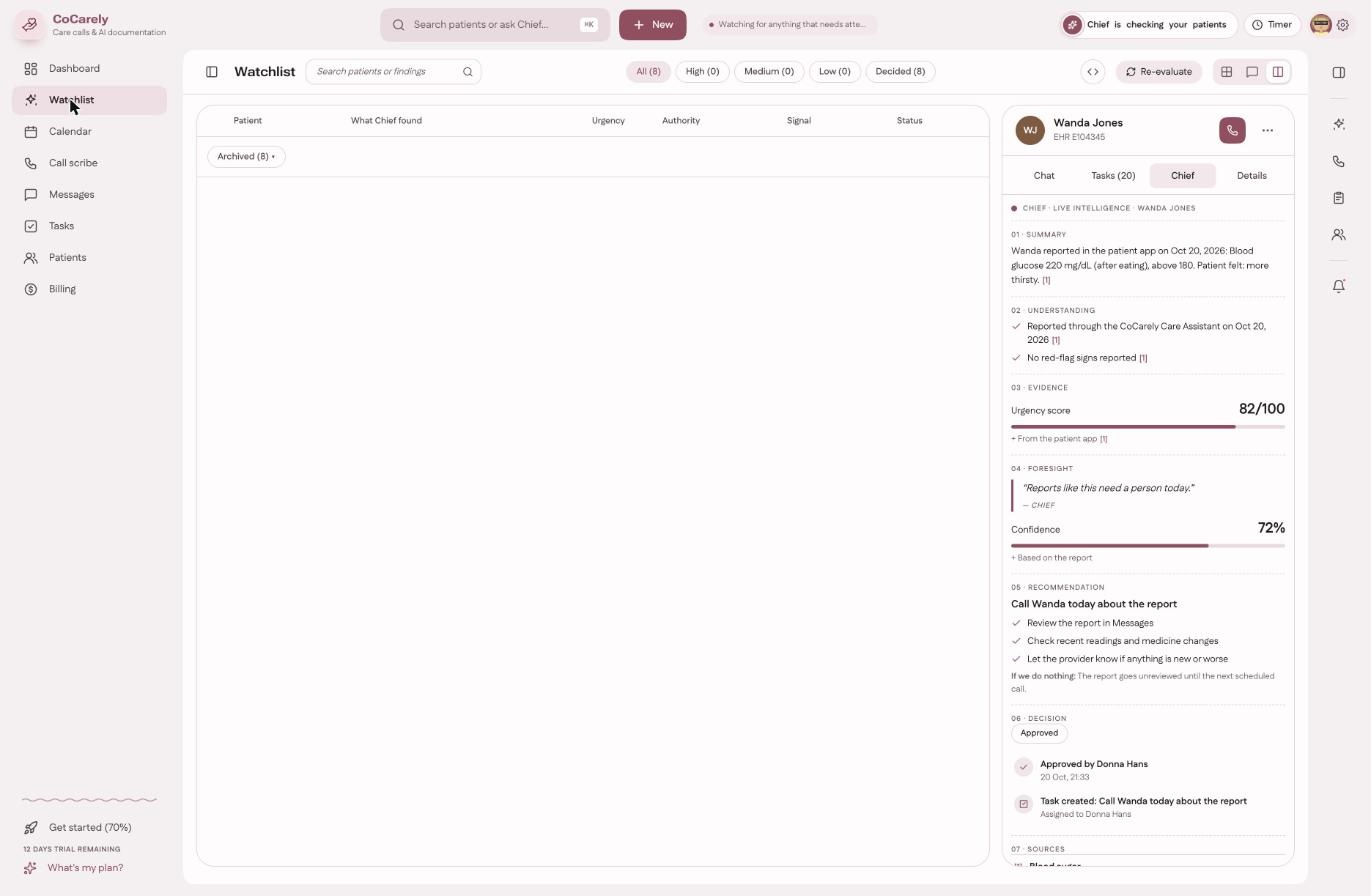
Smart alerts with a next step, approved by your team.
Outreach and check-in calls
Outreach and weekly check-ins, within your limits.
Intervention reports
Concerns, owners and next steps, in the doctor's feed.
Conversation starters
Openers for the next care call.
Education and quizzes
Lessons and quizzes from your material.
How Chief is built
Not a chatbot. A colleague with the whole picture.
A general chatbot knows medicine but not your clinic. Chief is built in layers, so every answer starts from your records and every action goes through the same rules your team follows. That system around the model is what makes Chief hard to copy.
Context before every answer
Before each turn, Chief reads a fresh brief: your visits today and this week, your tasks and the team's, forms waiting, recent scores, who wrote in, and the patient on your screen. It starts where you are, so you never have to explain.
One patient, one summary
Each patient has a single AI summary built from the chart, calls, readings and messages. The scribe, care plans, check-ins and Chief all read the same summary, so everyone works from the same story.
42 tools that act
Chief does the task: books and moves visits, sends forms and messages, creates tasks, sets goals, charts trends and finds care gaps against standard quality measures. It works inside your records, not beside them.
Rules it never breaks
Facts from the record, never clinical judgement. It only starts what it can finish. Anything that reaches a patient waits for a yes, respects opt-outs, and keeps calls and texts to contact hours.
A voice that knows when you are done
Chief listens with a turn-detection model trained on how people pause, so it waits while you think and answers when you finish. Talk over it and it stops to listen.
It gets better with you
A thumbs up or down on any answer goes back into how Chief replies. Every action is logged on the patient's audit trail, with who asked and what happened.
Chief’s medical council
Two AI minds. One careful answer.
Clinical notes deserve a second reader. Chief’s medical council checks AI work with two independent models, one from Anthropic and one from Google, before it reaches your team’s review.
One writes
Chief’s scribe turns the visit or call into a note, tasks and a care plan, using a model from Anthropic.
One checks
A medical model from Google reads the same transcript and the note side by side: is anything missing, or anything that was never said?
Scores are checked twice
Assessment results like the PHQ-9 and GAD-7 are scored by both, so a mismatch never slips through quietly.
Your team decides
When the two agree, the work moves on as usual. When they disagree, a nurse sees both views and makes the call. AI never makes the clinical decision.
Model names belong to their makers; CareDots is not affiliated with Anthropic or Google.
Connecting the dots
Chief draws the lines.
When a patient's data changes, the right person sees it.
A patient shares
A reading, answer, meal or message in PatientDot.
Chief notices
Checked against the care plan and goals.
The team decides
It lands on the Watchlist for approval.
The doctor sees it
Reports reach DoctorDot.
The loop closes
The patient hears back in their app.
AI helper dots
Meet the helper dots.
Chief's helpers for the busywork: calls, texts, follow-ups and bookings. You approve, they do the rest.
Each helper dot
One job each. Done well.
Ask Chief for something that touches many patients. It plans the run, picks the right helpers, and each helper does its part.
The Caller
Makes outreach and check-in calls, explains a program and records consent.
"Call everyone eligible for CCM this week."
The Messenger
Sends PatientDot messages first, then texts or email, in a warm voice.
"Remind my diabetics about their A1c."
The Scheduler
Books visits or sends a booking link the patient can pick from.
"Get my overdue follow-ups on the calendar."
The Assessor
Sends assessments like PHQ-9 and GAD-7, then nudges until they are done.
"Send a PHQ-9 to everyone due."
The Educator
Enrolls patients in guides and lessons from your material.
"Start the new hypertension guide for these patients."
The Coach
Sets the target your clinician chose and tells the patient why it matters.
"Set a blood pressure goal of 130/80 for this group."
The Coordinator
Creates tasks with an owner and a due date when a person is needed.
"Make a call-back task for anyone who didn't answer."
The Documenter
Drafts care notes for your review. Chief marks them; a person signs them.
"Draft a note for each check-in call today."
The Announcer
Sends clinic news to a whole panel: closures, flu shots, events.
"Tell everyone we're closed on Friday."
How they work
Ask once. Helpers do the rest.
- Plan. Who it will reach, and what it will say.
- Approve. Nothing goes out without a yes.
- Run. Helpers work the list.
- Report. What was done, and what needs a person.
Non-clinical work only; clinical decisions stay with your team.
Reading the dots
Every face means something.
You can tell what a helper is doing at a glance.
Calm
In its own shape with a neutral face: ready, waiting for the next job.
Working
It turns round and a ring fills around it as the job moves along. The eyes keep changing while it thinks.
Done
It springs back to its own shape with a big smile, and the task is checked off.
With Chief
All the work around the patient. Most of it, off your team's plate.
Every pill is a task a care team does to run a program. Turn Chief on and see what it takes: the calls, notes, logging and follow-ups. What stays are the decisions only people should make.
Continuum of care
Every dot matters on the continuum of care.
The closer a dot sits to the patient, the more it shapes their day. Doctors, nurses and family sit right beside them. Coders, insurers and the people who design and build the software float further out, fainter, but still connected. CareDots starts with the dots closest to the patient.
Around the patient, nearest first: doctor, nurse, caregiver, NP or PA and medical assistant; then front desk, pharmacist, behavioral health, dietitian, health coach, community health worker and home health aide; then specialist, pharmacy, lab, referral coordinator, medical coder, biller, practice manager and prior auth; then hospital, insurer, equipment supplier, quality analyst, compliance, EHR admin and credentialing; and furthest out, the people who build the technology: designer, developer, data scientist, product manager, researcher and support.
About
The truth between the dots.
Connect the dots, and care gets better.
Purpose
Humanity is the purpose.
Healthcare is where we begin.
Product-market fit
Let’s check if CareDots fits your business.
Tick the things your practice needs, from finding eligible patients to billing and phones. You get a fit score, the list of what works today, and what isn't ready yet, said plainly.